


Every summer, millions of visitors pack their bags and head to the East Coast’s most beloved beach towns. The boardwalks, the bars, the beach bonfires: it all feels like a world apart from real life. And that’s exactly the problem.
Memorial Day weekend marks the unofficial start of the summer enforcement season. From Ocean City to Wildwood to Dewey Beach, local police departments staff up, sobriety checkpoints go live, and fake ID scanning technology gets deployed at bars and clubs. The arrests that follow visitors home are not seasonal. They are permanent. The “vacation mindset,” the sense that normal rules do not apply when you are out of town, is, according to criminal defense attorneys who work these communities every season, the single biggest driver of summer arrests. Fake IDs, open containers, DUIs, disorderly conduct: the charges that follow people home long after their tans have faded are as predictable as the summer crowds themselves.
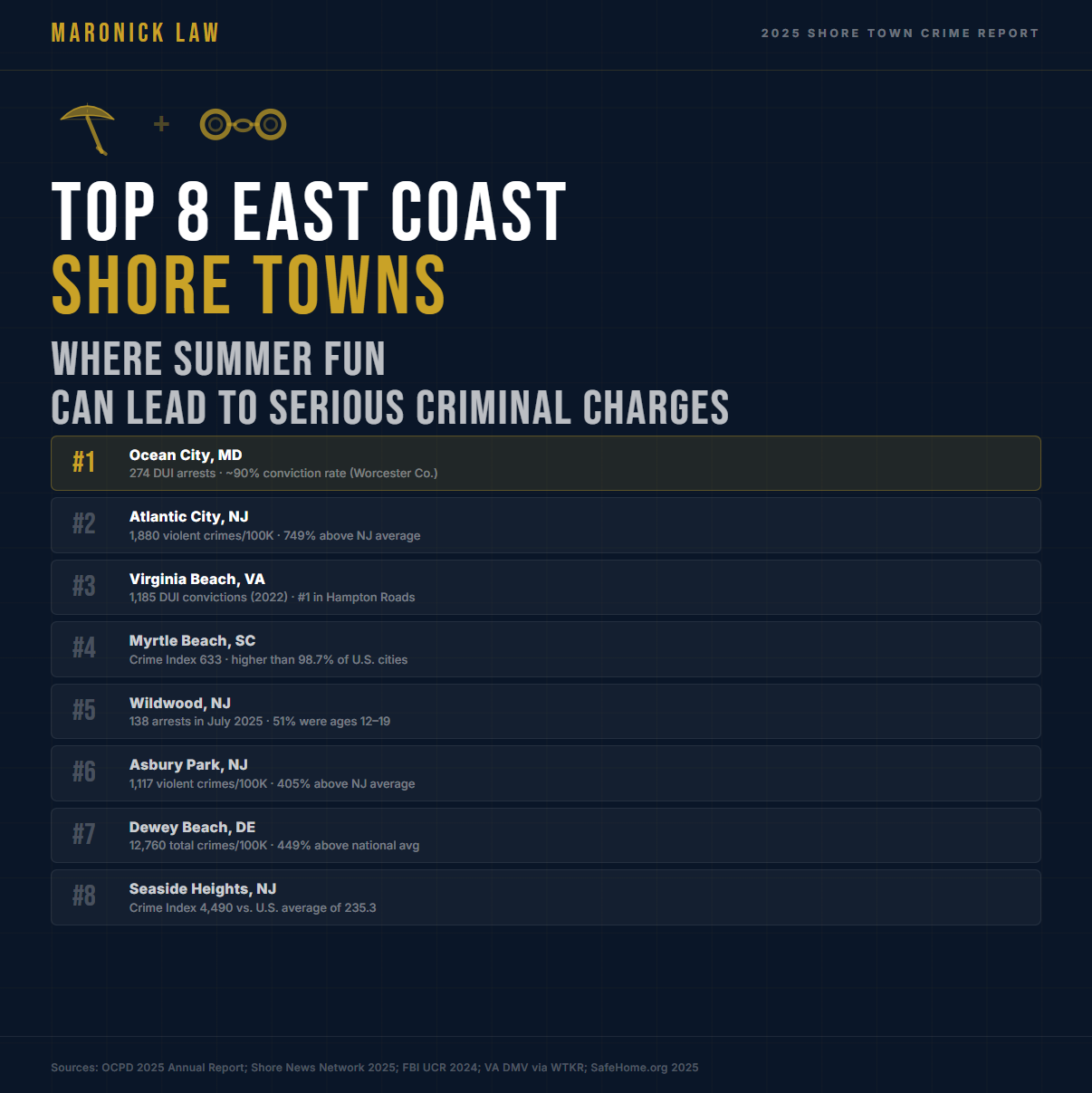
Here are eight East Coast shore towns where visitors are most likely to encounter law enforcement, and what you need to know before you go.
#1. Ocean City, MD
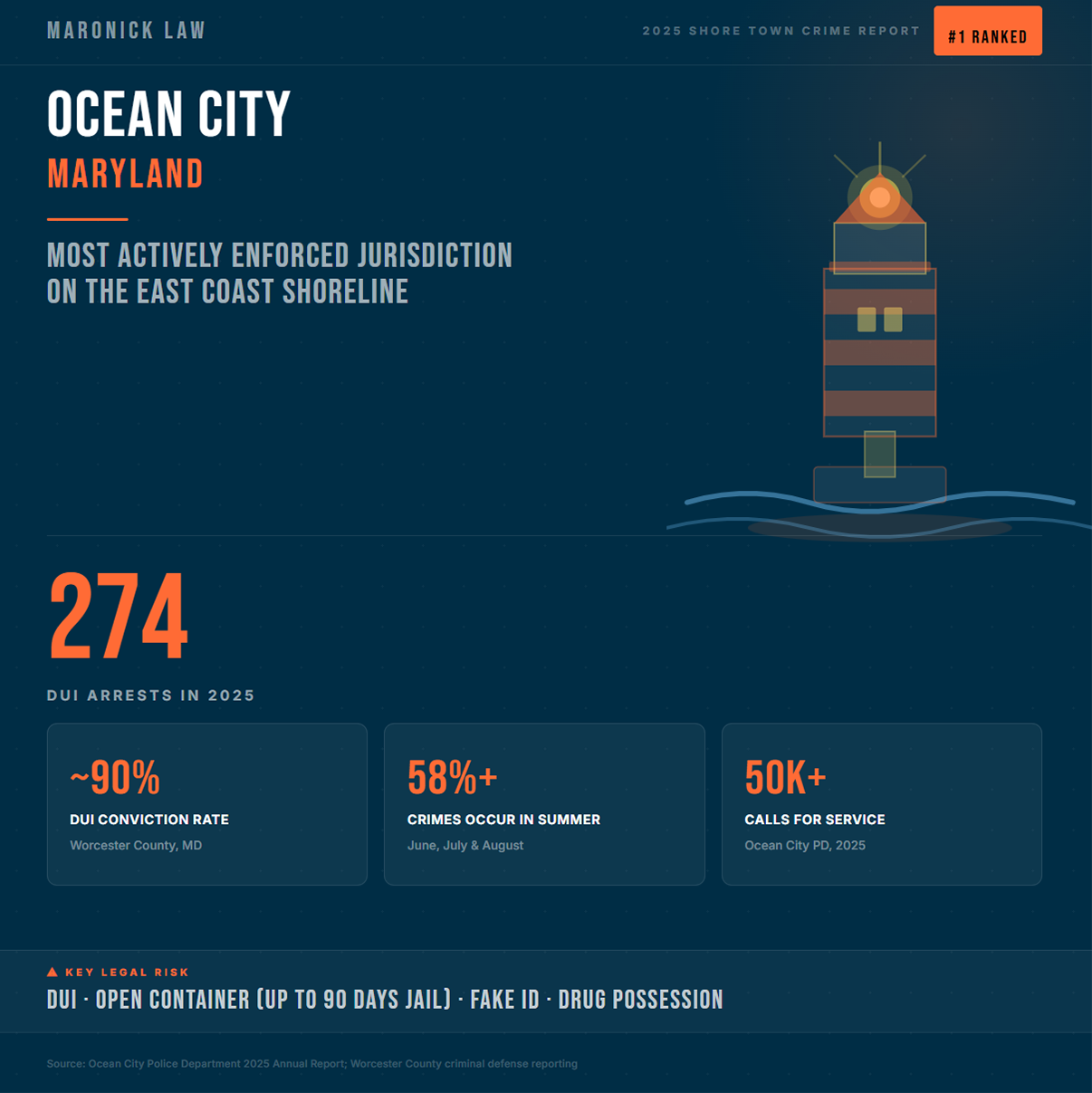
DUI arrests in 2025: 274
Summer crime concentration: More than 58% of all reported crimes occur in June, July, and August
Calls for service in 2025: Over 50,000
Approximate DUI conviction rate in Worcester County: approximately 90%
Annual DUI arrests: 300 to 350 per year; more than 60% between Memorial Day and Labor Day
Source: Ocean City Police Department 2025 Annual Report; Worcester County criminal defense reporting
Ocean City sits within Worcester County, where the consequences of a DUI are the most certain of any jurisdiction covered in this review. According to publicly reported data, approximately 90% DUI conviction rate reflects aggressive prosecution, extensive checkpoint evidence, and a judiciary that does not treat tourist town arrests lightly.
Open container violations under the Ocean City municipal code are punishable by up to 90 days in jail, a consequence that regularly blindsides first-time visitors accustomed to more permissive beach environments. Fake ID enforcement is active throughout the summer, and drug possession arrests spike in line with the seasonal population surge.
“People come to Ocean City assuming it will be a laid-back enforcement environment,” says Thomas Maronick Jr., a criminal defense attorney at Maronick Law LLC, which maintains an office in Ocean City. “It isn’t. The charges are real, and they follow you home.”
Key legal risk: DUI (with an approximately 90% conviction rate in Worcester County), open container violations (up to 90 days in jail), fake ID charges, and drug possession. One mistake on Coastal Highway can cost $10,000 or more in legal fees, fines, and insurance increases, plus a criminal record that follows you regardless of what state you call home.
#2. Atlantic City, NJ

Violent Crime Rate: 1,880 per 100,000 residents, 749% above the NJ state average
Overall crime risk: Approximately 1 in 11 residents
Property theft rate: Over 4,100 per 100,000 residents
Source: Shore News Network 2025; RoadSnacks 2024 NJ rankings (FBI UCR data)
Atlantic City is simultaneously New Jersey’s most visited tourist destination and one of its most dangerous cities. The violent crime rate is staggering: nearly 750% above the state average. Property theft is rampant, and car thieves specifically target rental vehicles in open-air lots near casinos.
Visitors who add alcohol to this environment face compounded risks. DUI enforcement is active on the Atlantic City Expressway corridors, and fake ID enforcement is aggressive in casino-adjacent bars and clubs. New Jersey treats false government identification as a criminal offense. Certain fake-ID offenses in New Jersey can be charged as fourth-degree crimes carrying penalties that may include up to 18 months in prison, fines up to $10,000, and driver’s license suspension.
Open-container violations in New Jersey can lead to fines and other penalties, especially when combined with DUI or disorderly conduct allegations. Disorderly conduct charges, often the result of alcohol-fueled confrontations in and around casino corridors, carry up to 6 months in jail under New Jersey law.
Key legal risk: The full spectrum: theft, assault, DUI, and fake ID charges. Atlantic City’s crime density means encounters with law enforcement are statistically more likely here than anywhere else on the New Jersey Shore.
#3. Virginia Beach, VA

DUI convictions (2022): 1,185, the highest in the Hampton Roads region, more than double the next-closest city
National ranking: Top 10 U.S. cities for drivers with DUIs on record
Source: Virginia DMV data via WTKR News 3 investigation; QuoteWizard/LendingTree study
The Virginia Beach Police Department maintains a specialized DUI enforcement unit so well-regarded that it trains agencies across Virginia. Most arrests concentrate around the Oceanfront entertainment district, Town Center, and Shore Drive, the same corridors where the city’s summer nightlife is most concentrated.
Virginia Beach Commonwealth Attorney Colin Stolle has stated publicly: “If you get behind the wheel of a car when you have been drinking, there is a good chance that Virginia Beach Police are going to catch you.”
A first DUI offense in Virginia carries a mandatory minimum $250 fine, a 12-month license suspension, mandatory alcohol safety classes, and a criminal record. Second offenses carry mandatory jail time. The consequences are not theoretical, and they follow visitors home regardless of what state issued their license.
Key legal risk: DUI. A first offense in Virginia carries a mandatory minimum $250 fine, a 12-month license suspension, mandatory alcohol safety classes, and a criminal record.
#4. Myrtle Beach, SC
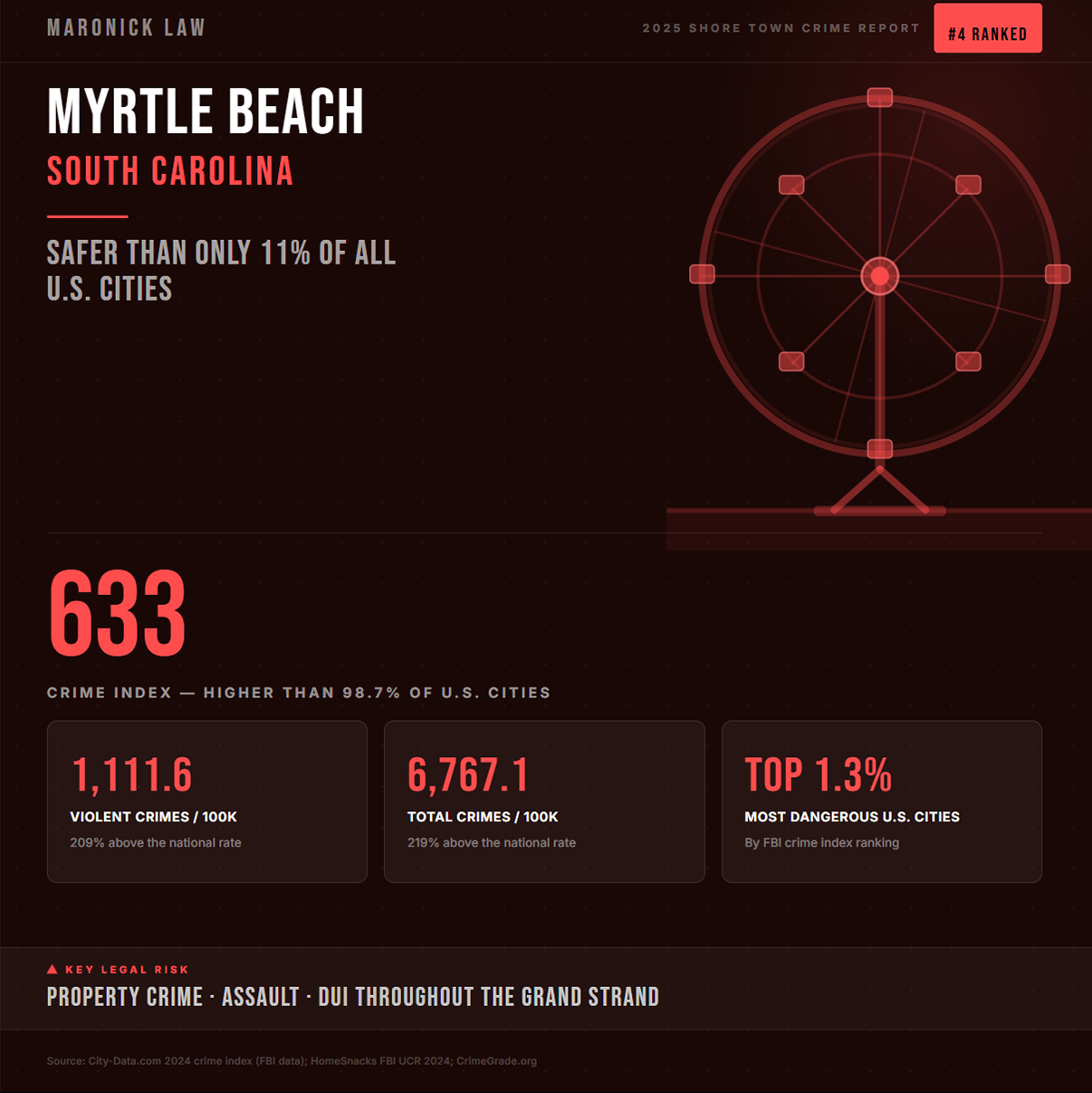
Crime Index: 633, higher than 98.7% of U.S. cities
Violent Crime Rate: 1,111.6 per 100,000 residents, 209% above the national rate
Total Crime Rate: 6,767.1 per 100,000, 219% above the national rate
Source: City-Data.com 2024 crime index (2024 FBI data); HomeSnacks FBI UCR 2024
Myrtle Beach is safer than only 11% of U.S. cities, a fact that stands in sharp contrast to its identity as a leisure destination. The dense nightlife corridor along Ocean Boulevard and the surrounding entertainment districts generates a consistent pattern of alcohol-related arrests throughout the summer season.
Property crime is the most statistically prevalent risk: visitors who leave vehicles, hotel rooms, or beach gear unattended are frequent targets. But DUI enforcement is active throughout the Grand Strand, and South Carolina’s penalties for impaired driving are significant.
Under South Carolina Code § 56-5-2930, a first DUI offense carries a mandatory fine of $400 (plus assessments that typically bring the total to approximately $1,000), a six-month license suspension upon conviction, and between 48 hours and 30 days in jail for a BAC between 0.08% and 0.15%. Drivers with a BAC of 0.16% or higher face a minimum of 30 days and up to 90 days in jail. A second offense within 10 years carries a mandatory minimum of five days in jail (or 30 days of community service), a fine of $2,100 to $5,100, and a nine-month license suspension for refusal to test. Under South Carolina's implied consent law (§ 56-5-2950), refusing a breathalyzer triggers an automatic 90-day license suspension on a first offense, independent of any DUI charge.
Key legal risk: Property crime, assault, and DUI. South Carolina’s first-offense DUI carries mandatory jail exposure and a 6-month license suspension. Myrtle Beach is safer than only 11% of U.S. cities, a sobering fact for a town most people associate with vacation.
#5. Wildwood, NJ
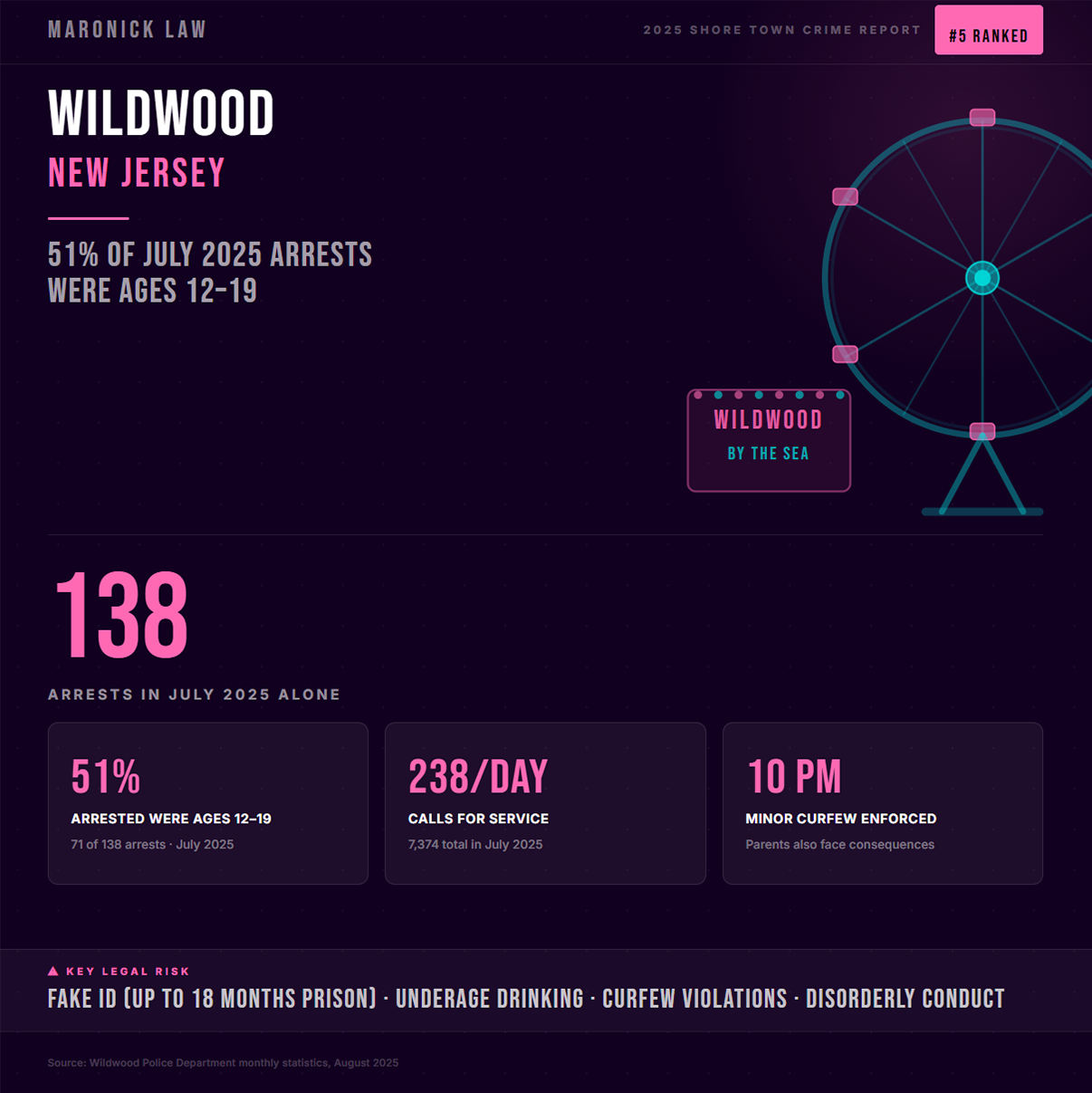
Arrests in July 2025: 138, of which 71 (51%) involved individuals aged 12 to 19
Calls for service in July 2025: 7,374, approximately 238 per day
Source: Wildwood Police Department monthly statistics, August 2025
In 2025, Wildwood strictly enforced a 10 PM curfew for all minors. Mayor Ernie Troiano made clear: “This isn’t a suggestion. It’s the law.” Both the minor and the parents can face consequences for violations.
Fake ID enforcement is a particular focus. Bar owners in neighboring North Wildwood have publicly described being victimized by professionally produced fake IDs virtually indistinguishable from real ones, prompting investment in handheld ID scanning technology at local establishments. In New Jersey, possessing or using a false government-issued ID can be charged as a fourth-degree crime, carrying up to 18 months in prison, fines up to $10,000, and a mandatory 6-month driver’s license suspension.
Many of those arrested in Wildwood in July 2025 were from out of state: West Chester, Willow Grove, Moorestown, Pennsauken, and Philadelphia. Distance from the jurisdiction provides zero legal protection. Missing a court date results in a bench warrant.
Key legal risk: Fake ID arrests, underage drinking citations, curfew violations, and disorderly conduct. With 238 daily calls for service in July alone, Wildwood police are fully resourced.
#6. Asbury Park, NJ
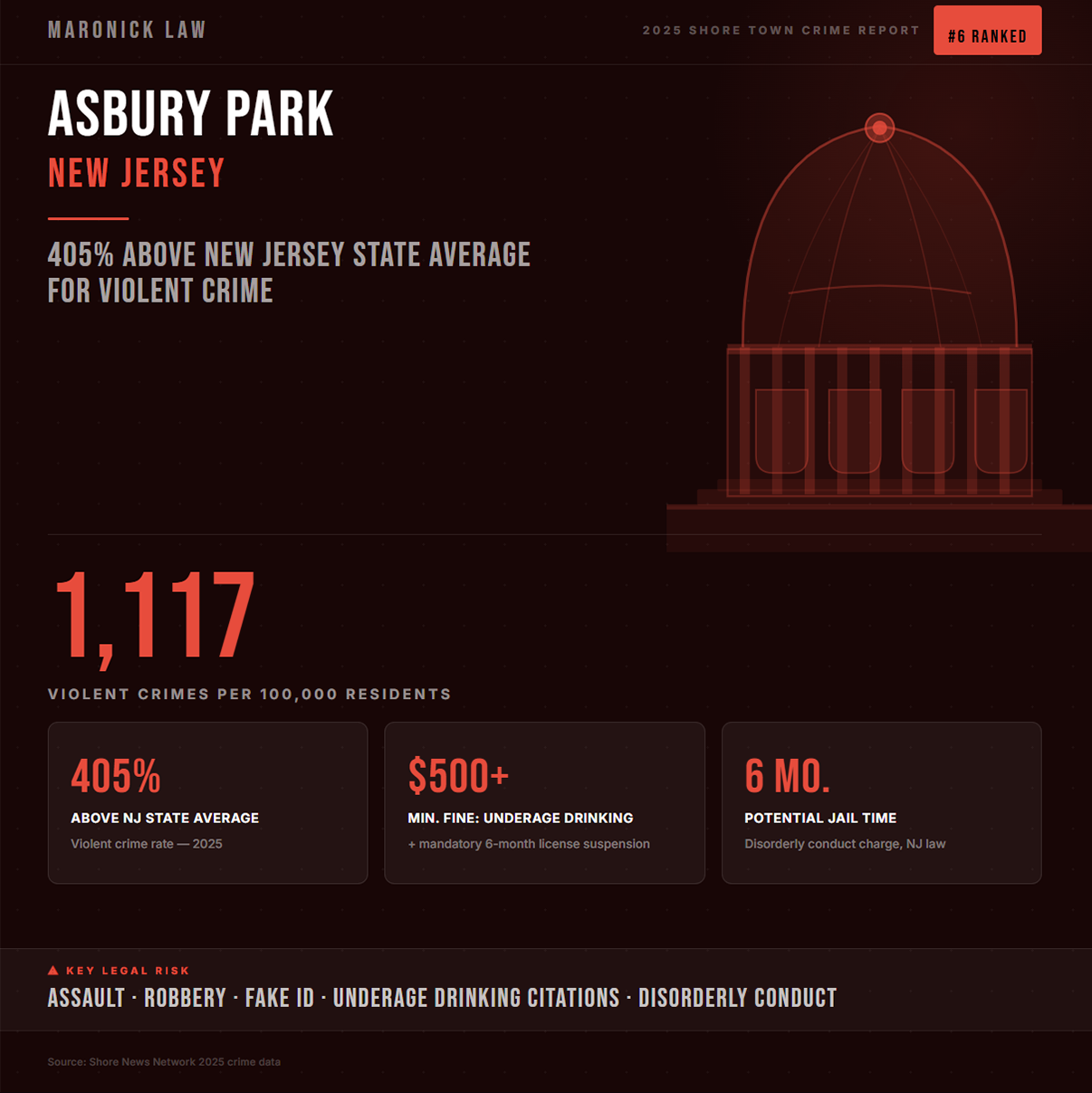
Violent Crime Rate: 1,117 per 100,000 residents, 405% above the New Jersey state average
Source: Shore News Network, 2025 crime data
The violent crime rate in Asbury Park is driven largely by assaults and robberies, and bar-related incidents rise after midnight along Cookman Avenue and in the surrounding entertainment district. Visitors should be aware that New Jersey treats false government identification as a criminal offense, not a minor infraction. Fake ID enforcement is active in the venues that define Asbury Park’s summer economy.
Underage alcohol offenses in New Jersey can result in fines, community service, and driver’s license consequences depending on the circumstances and the specific charge. Disorderly conduct charges carry up to 6 months in jail. Neither is a civil fine.
Key legal risk: Assault charges, fake ID arrests, and underage drinking citations.
#7. Dewey Beach, DE
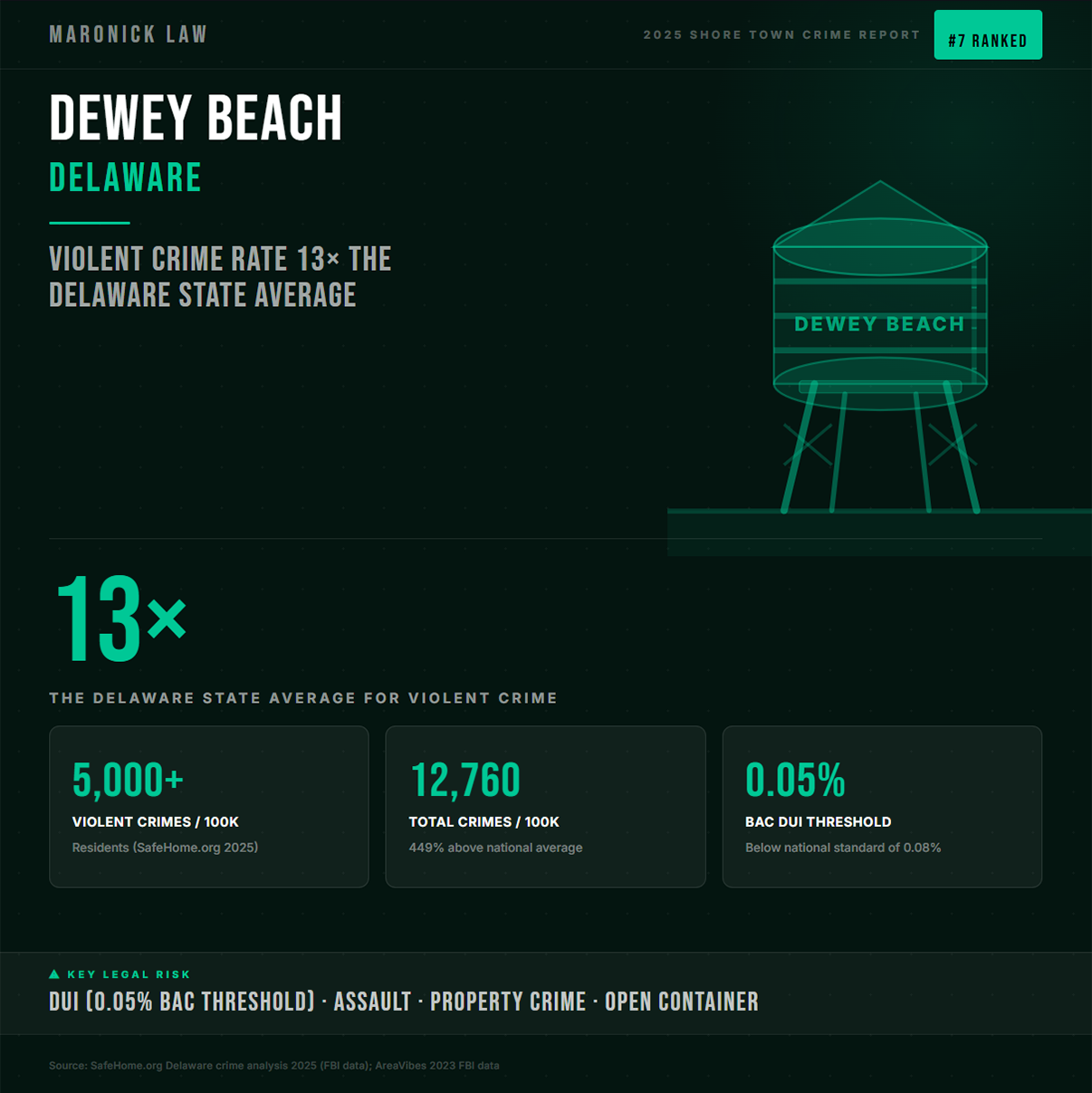
Violent Crime Rate: More than 5,000 incidents per 100,000 residents, 13 times the Delaware state average
Overall Crime Rate: 12,760 per 100,000 residents, 449% above the national average
Permanent population: approximately 350, swelling to 30,000 or more in summer
Source: SafeHome.org Delaware crime analysis, 2025 (FBI data); AreaVibes 2023 FBI data
The per-capita crime statistics in Dewey Beach are driven by the dramatic disparity between its tiny permanent population and its massive summer crowds. A handful of incidents in a town of 350 people produces outsized rates, but the underlying enforcement activity is real and consistent with a community that draws tens of thousands of visitors each weekend.
Delaware’s DUI statute (21 Del. C. § 4177) operates differently from what many visitors expect. Under Delaware law, drivers can still face DUI charges below the 0.08% BAC threshold if prosecutors allege impairment based on the surrounding evidence. A first DUI offense in Delaware carries fines of $500 to $1,500, a license revocation of 12 to 18 months depending on BAC, and mandatory installation of an ignition interlock device.
Property crime, particularly theft from vehicles and beach rentals, is the most common category of offense. Open container violations are actively enforced.
Key legal risk: Assault, property crime, and DUI. Delaware’s DUI statute (21 Del. C. § 4177) allows prosecution to begin at BAC levels well below the 0.08% standard most visitors assume, a critical fact for anyone drinking in Dewey Beach.
#8. Seaside Heights, NJ
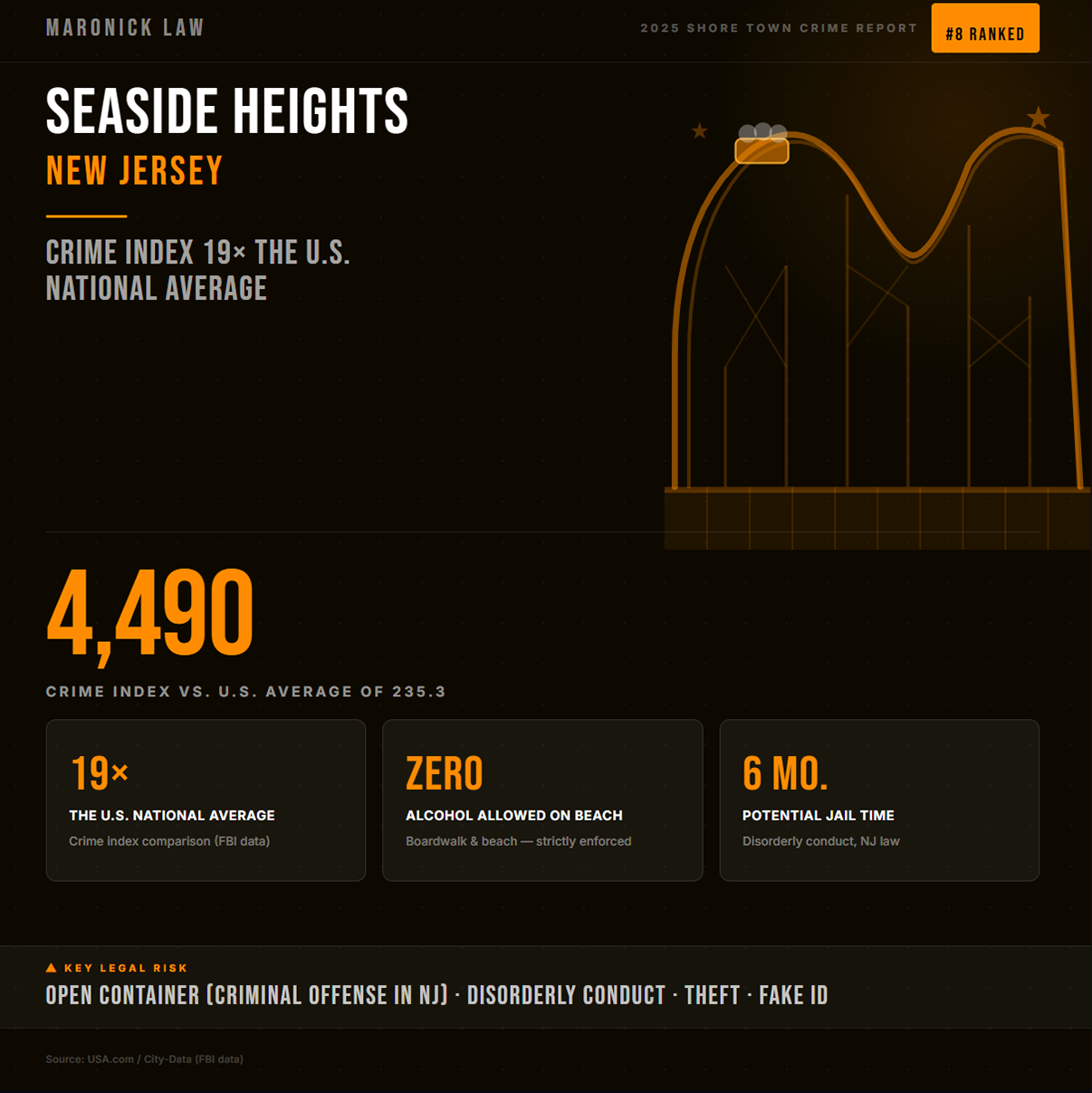
Crime Index: 4,490 (U.S. average: 235.3)
Source: USA.com / City-Data (FBI data)
Theft, vandalism, and drug-related offenses spike sharply during summer months in Seaside Heights. Alcohol is prohibited on both the boardwalk and beach, and the town maintains an active police presence throughout peak season. New Jersey prohibits open alcoholic beverage containers in motor vehicles, and violations can result in fines and court appearances.
Disorderly conduct charges, often the result of alcohol-fueled incidents on the boardwalk or in the surrounding entertainment areas, carry up to 6 months in jail under New Jersey law. Fake ID enforcement is active in the bars and clubs that drive the town’s summer economy. New Jersey treats false government identification as a criminal offense that can escalate to a fourth-degree crime depending on circumstances.
Key legal risk: Open container citations and disorderly conduct. These are criminal offenses in New Jersey, not civil fines.
5 Legal Safety Tips for Shore Visitors
- Plan your transportation before the first drink, not after the last. Rideshare availability drops after 2 AM in most shore towns precisely when demand peaks. Decide on a plan before you go out.
- A fake ID is a criminal instrument, not a prop. In New Jersey, fake-ID offenses can lead to serious criminal penalties, including indictable charges, substantial fines, incarceration exposure, and driver’s license consequences. Maryland imposes similarly significant penalties.
- Open containers carry real jail exposure. In Ocean City, MD, an open container violation is punishable by up to 90 days in jail. In New Jersey, alcohol control statute violations trigger mandatory fines and a 6-month license suspension. None of these are parking tickets.
- Out of state does not mean out of reach. Missing a court date because you live hours away results in a bench warrant. Distance from the jurisdiction provides zero legal protection.
- Stop talking. Call a lawyer. If you are arrested, exercise your right to remain silent immediately. Request an attorney before answering any questions. Statements made at the scene are evidence, and every shore town on this list is served by prosecutors who handle these cases every single summer.
About the Author
Thomas J. Maronick Jr. is the Senior Partner at Maronick Law LLC, a premier Maryland criminal defense and personal injury firm with offices in Ocean City, Glen Burnie, Baltimore, Towson, Bel Air, Easton, Westminster, and Rockville. He is licensed in Maryland state and federal courts, the U.S. District Court for the District of Columbia, the U.S. Court of Appeals for the 4th Circuit, and is a proud member of the U.S. Supreme Court Bar.
Mr. Maronick focuses his practice on criminal defense, DUI/DWI, personal injury, catastrophic injuries, bankruptcy, family law, and business law. He has litigated cases across the state of Maryland and has handled several high-profile criminal defense matters that have received national media coverage, including in The New York Times, USA Today, CNN, and The Baltimore Sun. He is a regularly sought-after legal analyst providing expert commentary on major criminal cases in regional and national media.
Mr. Maronick’s Ocean City office serves clients from across the mid-Atlantic who face criminal charges stemming from visits to the Maryland Shore. He is available 24 hours a day, 7 days a week, including weekends.
Contact: 443-551-2747 (Ocean City) | 443-551-2747 (Main) | info@maronicklaw.com | maronicklaw.com
Sources
Ocean City Police Department 2025 Annual Report; Shore News Network 2025 NJ Dangerous Towns Report; RoadSnacks 2024 NJ Rankings (FBI UCR data); Wildwood Police Department July 2025 Monthly Statistics; SafeHome.org Delaware Crime Analysis 2025 (FBI data); AreaVibes Dewey Beach 2023 FBI data; City-Data.com 2024 crime index (2024 FBI data, Myrtle Beach); HomeSnacks FBI UCR 2024 (Myrtle Beach); CrimeGrade.org (Myrtle Beach); Virginia DMV DUI data via WTKR News 3; QuoteWizard/LendingTree DUI study (Virginia Beach); Worcester County DUI enforcement reporting; N.J.S.A. 2C:21-2.1 (NJ False ID statute); Ocean City MD Municipal Code (open container); S.C. Code Ann. § 56-5-2930 (SC DUI statute); S.C. Code Ann. § 56-5-2950 (SC implied consent); 21 Del. C. § 4177 (Delaware DUI statute).